

Six and a half metres below Uluwatu’s clifftop lawns lies a limestone hollow – home to The cave by Chef Ryan Clift. A new menu has just arrived. Every four months, Chef Ryan Clift sends a fresh tasting menu down the spiral staircase into this 25,000-year-old chamber, and the 14th Edition marks the boldest iteration yet – a menu built not simply to be tasted, but disturbed: cracked open, poured over, exhaled upon. Each edition introduces an entirely new tasting journey, and this one leans further into interaction than any before it. Dining here has always carried a theatrical undercurrent. This time, the guest becomes part of the performance.

Dining beneath a 25,000-year-old cave
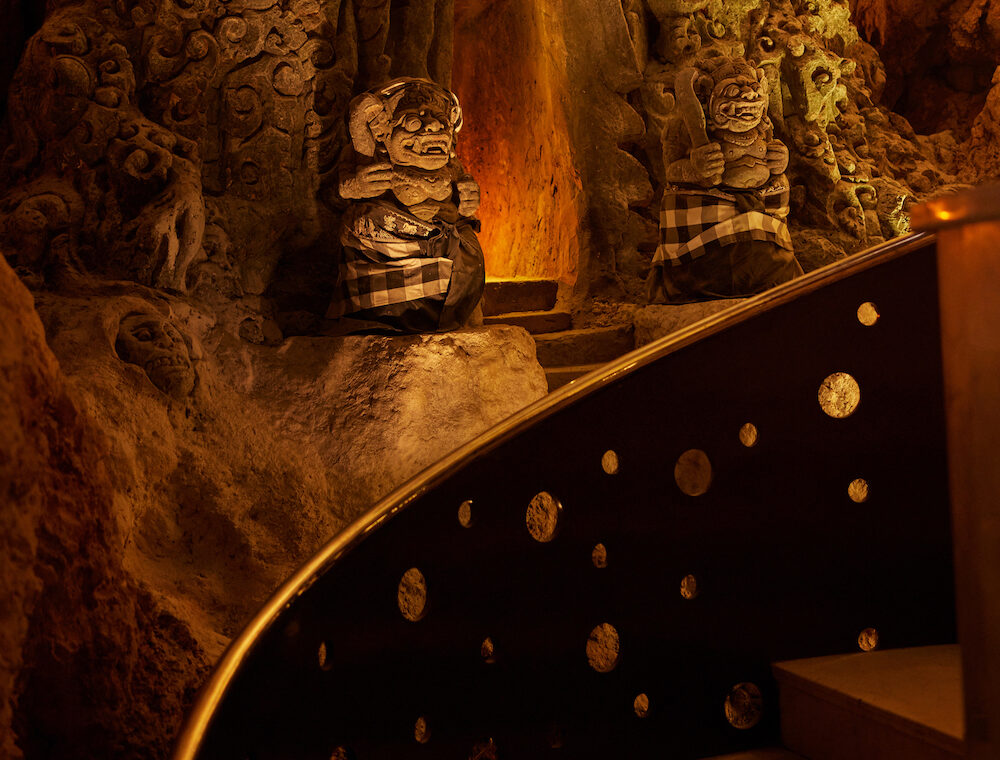
The chamber was uncovered in 2013, during construction on the property now known as The edge Bali, when builders working on a villa above broke through rock and found the cave waiting beneath them. Rather than sealing it, the team conserved it – stalactites left hanging as they had grown, crescent walls left rough and unpolished – and eventually reimagined it as one of Southeast Asia’s most unusual dining rooms.
Descend the staircase today and the shift is immediate. The air cools. The tropical hum above falls away, replaced by a hush that makes cutlery sound louder and conversation instinctively quieter. Sound gathers close in a room like this rather than scattering, which is part of why 22 strangers at table can feel intimate within a course or two. There is no view to compete with the plate, no natural light to shift the mood – only the porous grain of limestone, an irregular ceiling still hung with stalactites mid-formation, and the pooled light the kitchen projects across the walls between courses.
Capacity is capped at 22 seats, a constraint that keeps the room from competing with itself acoustically or thermally. A dish built for temperature contrast behaves differently in a space that never fluctuates – and that constancy is precisely what Clift’s kitchen has learned to build against.
The vision behind Chef Ryan Clift’s menu
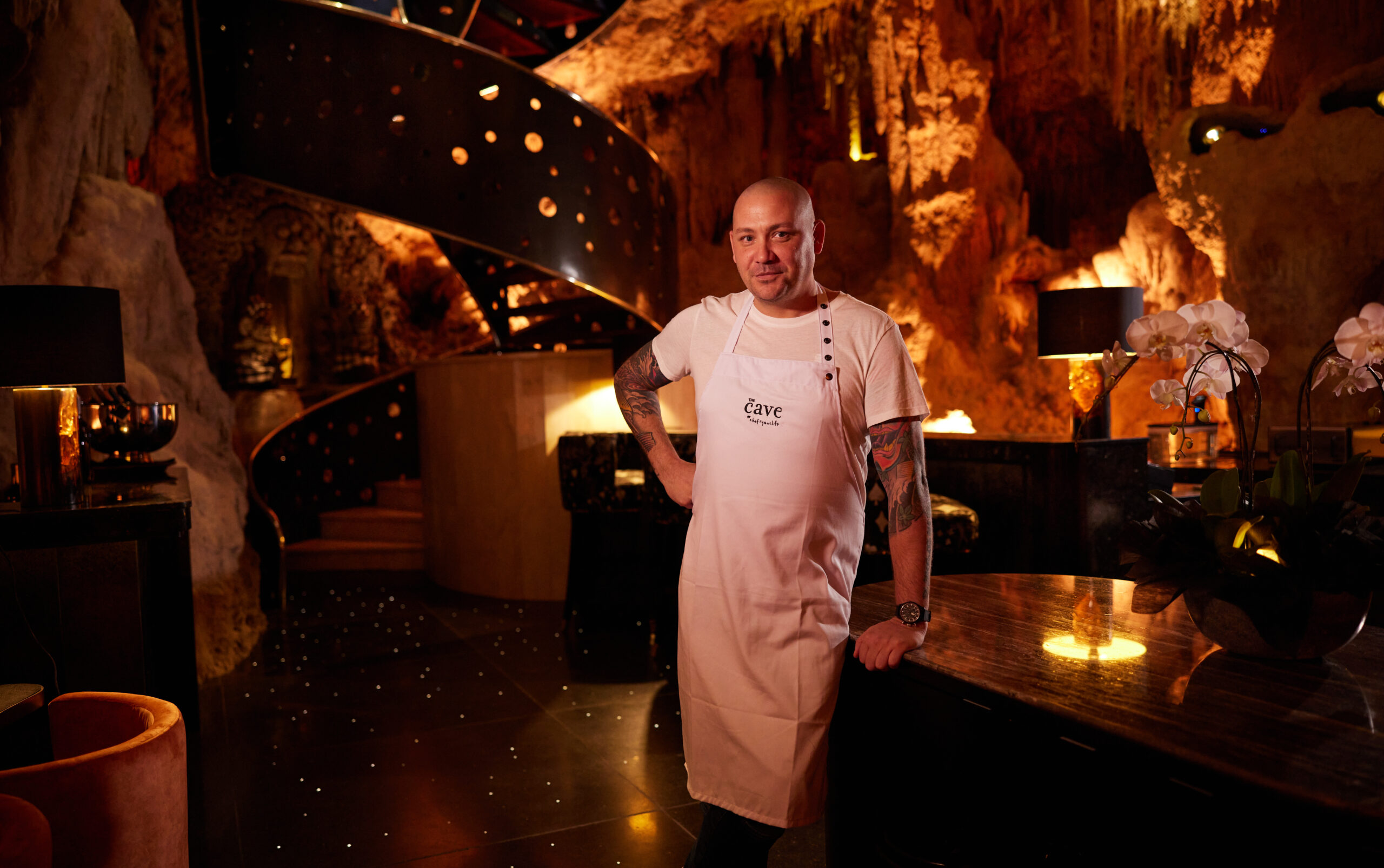
Chef Ryan Clift’s cooking has long treated flavour and technique as a single problem to solve, not two separate exercises – a habit sharpened across kitchens in the UK, Australia and Singapore, and carried into every menu he has built since. His signature is less a specific dish than a persistent appetite for surprising a guest without losing the thread of flavour: bold pantry references drawn from well beyond one cuisine, classical technique used as scaffolding rather than the final word.
That approach explains why The cave by Chef Ryan Clift has become one of the defining names in fine dining in Uluwatu, resetting its menu every four months rather than settling into a fixed repertoire. Each edition pushes the room’s possibilities a little further – how far a temperature contrast can travel before it stops feeling considered, how much interruption a guest will accept before spectacle overtakes flavour. The 14th Edition goes further than most. It’s technically ambitious and unafraid of theatre, but flavour still leads.

Inside the 14th edition
The four-month cycle is a demanding one for The Cave’s kitchen to sustain, and it shows in how differently this menu reads from what came before it. Temperature and texture are no longer background elements here – they’re the point. Several courses are only complete once the guest has intervened: shattering a chip into a mousse, exhaling over a frozen foam to watch vapour lift off the plate, letting a broth be poured tableside over bread rather than delivered assembled. The kitchen calls this “interactive drama,” and the phrase is more literal than most menu copy tends to be. These dishes have a second act, and it only happens once the diner acts on them.
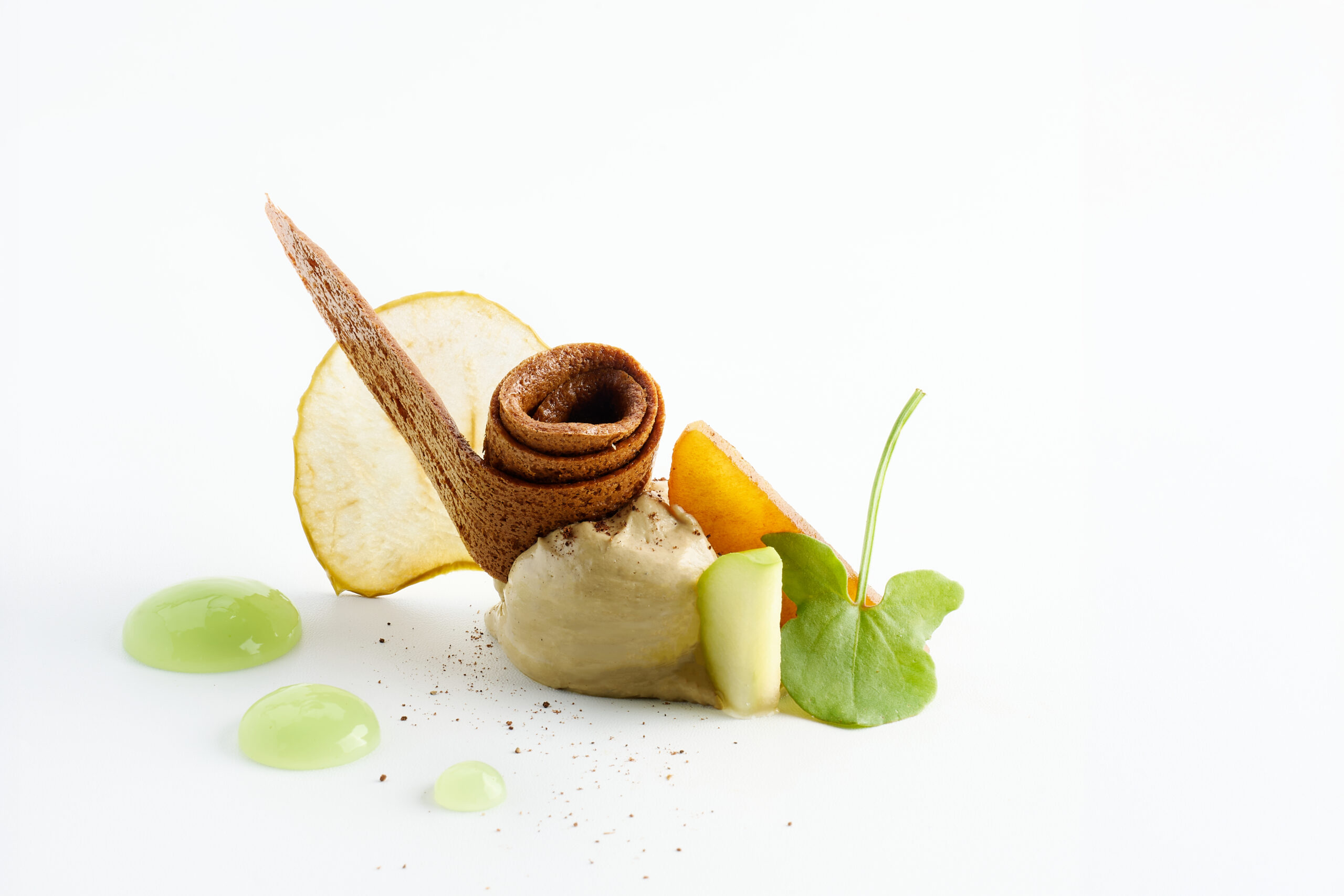
The shift is deliberate. Earlier editions leaned toward layered richness. The 14th turns instead on interruption, asking the guest to physically alter a course before eating it. It’s a small but consequential change in what a tasting menu can ask of someone at the table, and it suits a room built from raw stone rather than polished surfaces. Food that simply sits still on the plate has never quite matched the space around it. The centrepiece course captures this best: it only comes together once the guest has cracked a delicate gaufrette biscuit into the foie gras mousse beneath it.
What ties it together is a globally inspired pantry. A Spanish paella technique turns up reimagined in a seafood course. A French bouillabaisse shares a plate with warm eight-spice and bright yuzu. Peruvian citrus sits beside Japanese kombu-curing, and none of it feels like fusion for its own sake – each reference earns its place, sharpening a texture or cutting through a richness at exactly the right moment. Later in the meal, a nitrogen-frozen meringue served over a cooling sorbet pushes the same idea into something closer to spectacle. Exhale over it, and a curl of vapour lifts off the plate. Return in four months and almost none of it will still be here. That’s rather the point.
The progression itself is carefully paced. The meal opens gently, with warm Parker House milk bread and a bouillabaisse poured tableside, before moving into the sharper, more assertive notes of a hamachi tart. The Foie Gras Apple arrives roughly midway through as the meal’s emotional high point, before the kitchen shifts into savoury depth with Gindara and then a richer, more grounded Duck Katsu. By the time the Yuzu Meringue appears, the palate has been reset and readied for dessert, closing eventually with Bounty Paradiso – a reworking of a familiar coconut-chocolate pairing that sends the meal out on something playful rather than heavy. Nothing here reads as a checklist. It’s a deliberate rise and fall, engineered to hold attention across two hours underground.

Beyond the plate
The 14th Edition at The Cave by Chef Ryan Clift runs across seven and 10 courses. The seven-course menu is served simultaneously to the entire room, with four projected interludes washing across the cave walls between courses. The 10-course option, offered at lunch and the later dinner seating, extends the same themes – interruption, contrast, tableside finishing – across a longer arc, adding further courses that lean into richer, more indulgent territory before the meal’s close. Both formats pair with wine or cocktails selected to track the food’s own swings in temperature and intensity, rather than running as a separate list alongside it. Few tables offer a more distinctive way to spend an evening – or a dinner in Uluwatu quite like it.
The pacing here differs from a conventional tasting menu room mainly through what’s absent: no changing view, no ambient noise from neighbouring tables, no daylight shifting the mood course to course. Dishes are finished tableside, since open cooking underground isn’t possible, and each course is explained with a level of detail that assumes real curiosity rather than a diner simply waiting to be fed. It doesn’t quite feel like a typical restaurant service – it feels closer to a small, deliberate evening among people who know exactly what they’re doing.
A new chapter underground
Every four months, a new menu meets a room that has taken 25,000 years to form, and each edition of The cave by Chef Ryan Clift finds its own balance between spectacle and flavour. The 14th leans further into interruption than any before it – a shattered gaufrette chip, a broth poured tableside, a curl of frozen vapour rising off a plate in the dark – without ever losing sight of what’s actually on the fork. Like every edition before it, the 14th will only be served for a limited run before a new one takes its place. Guests hoping to experience it are best advised not to wait for the next.
Frequently Asked Questions
Where is The cave by Chef Ryan Clift located?
The cave by Chef Ryan Clift is set within The edge Bali, a clifftop villa resort in Pecatu, Uluwatu, on Jalan Pura Goa Lempeh, Banjar Dinas Kangin.
What is the 14th Edition Menu?
The 14th Edition is the latest seasonal tasting menu at The Cave by Chef Ryan Clift, built around temperature contrast, texture and diner interaction, with a centrepiece foie gras and green apple course designed to be shattered and disrupted at the table.
How many courses are available at The cave?
Guests can choose between a seven-course menu, served simultaneously across the room with four projected interludes, or an optional 10-course menu available at lunch and the 9pm dinner seating.
Why does the menu change every four months?
Chef Ryan Clift resets the menu on a four-month cycle so returning guests always encounter a genuinely new experience, and so the kitchen can keep testing fresh ideas against the cave’s distinctive temperature, acoustics and light.
Is The cave suitable for special occasions?
The intimacy of the 22-seat cave, along with its wine and cocktail pairing options, makes it a considered choice for milestone dinners and special-occasion dining in Uluwatu. Its candlelit, subterranean setting has also made it a favourite among Bali’s most romantic restaurants for proposals and anniversaries. Special event pricing, menu and timing may vary.
What makes The cave different from other fine dining restaurants in Bali?
Beyond its setting inside a 25,000-year-old natural cave – believed to be the first subterranean restaurant of its kind in Indonesia – The cave by Chef Ryan Clift distinguishes itself through a kitchen that treats the room’s physical constraints as a creative tool, building each new tasting menu specifically for the cavern’s temperature, acoustics and light.
For reservations, email intouch@theedgebali.com or call +62 82144632077 | theedgebali.com.