


Few countries on earth contain as much contradiction within a single set of borders. Some of its most remote Indonesian islands are also its most rewarding. Indonesia spans more than 17,000 islands across three time zones. It is home to over 700 living languages and hundreds of distinct ethnic groups, each shaped by a different stretch of coastline, forest or volcanic ridge. Within a single week of travel, the landscape can shift from savannah to rainforest. It can shift from the collapsed crater of one of history’s most violent volcanic eruptions to coral atolls holding the richest concentration of marine life on the planet.
Off Sumba’s coast, a line of horses walks into the Indian Ocean. Riders sit low over their necks as the swell climbs past the animals’ shoulders. Near the smouldering outline of Mount Tambora, a shape the length of a delivery truck rises slowly out of the blue. A small boat of divers holds its breath beneath it. Over Raja Ampat, manta rays wider than a dining table circle a limestone karst rising sheer from turquoise water. In the South China Sea, a seaplane banks low over a lagoon so clear the reef is visible from the cabin window before the floats touch down. On a stretch of black volcanic sand in North Sulawesi, something no larger than a fist reshapes itself mid-stride into the outline of a flatfish, and vanishes. None of it is staged. It happens daily, whether or not anyone is there to see it.
Five Islands, Five Different Indonesias
Five resorts across the archipelago reveal entirely different versions of this country. Each is built around a corner of Indonesia unlike any other:
- NIHI Sumba – cliffside villas above a private surf break, and a beach where horses enter the sea
- Amanwana – beachfront tents inside a protected national park east of Bali
- Bawah Reserve – a six-island archipelago in the South China Sea, reachable only by seaplane
- Misool Resort – water cottages above one of the most successful reef recoveries on the planet
- Coral Eye Bangka – a working marine research station turned boutique retreat on the edge of the Coral Triangle
What follows is a journey through five remote Indonesian islands, and the resort each one is built around.
NIHI Sumba: Horses, surf and Sumba’s wildest coast
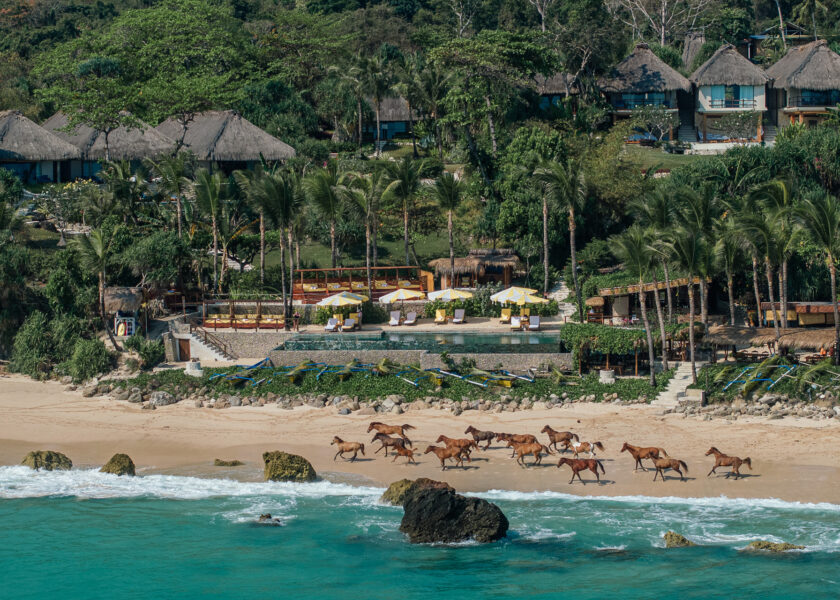
The approach alone sets the tone. Villas at NIHI Sumba are built into the hillside above Nihiwatu Beach, cliffside and thatched. Each one is angled to hold the full 2.5-kilometre curve of white sand and the Indian Ocean beyond it in view from the bed. The surf is close enough that its sound never quite disappears, even at night. There is no shared beachfront to negotiate, no crowd to filter out of the frame. The resort’s position on this particular stretch of coastline was chosen decades ago, specifically because of what happens on the sand and in the water below it. Everything built since has been designed not to compete with that view, but to frame it.
What happens on that beach is available exclusively through NIHI. Sumbanese horsemen and their Sandalwood ponies meet guests at the shoreline as part of a curated experience run by the resort’s own equine team. The ponies are small, sure-footed animals native to the island for centuries. Guests ride saddled, guided into the surf by an experienced handler, salt spray rising as the horse’s stride shifts from sand to swell. The animal never breaks pace.
Nihioka: A spa built around retired horses
Fifteen minutes from the beach, Nihioka spreads across a hundred acres of former farmland. NIHI has shaped it into a spa destination in its own right, part sanctuary for the resort’s retired horses, part retreat from the ocean altogether. Guests reach it by trek, cycle or horseback along a route through rice terraces and village outskirts. They arrive at an open-air spa built directly into the landscape: treatment bales facing the water, a treehouse platform for breakfast suspended above a private cove few outside the resort ever see.
Nihioka’s treatment menu ranges from traditional Sumbanese massage to a signature offering found nowhere else on the property. The massage’s specialised stomach work is rooted in a local belief that the stomach functions as the body’s second brain. The signature offering is Equine Wellness, built around proximity to the sanctuary’s retired horses. During a massage, a horse is brought to stand beside the treatment table rather than left in a nearby paddock. It stands close enough that its breath is audible, and its weight occasionally shifts so a nose or muzzle grazes an arm or shoulder mid-session. Reiki sessions unfold the same way, guests lying in the grass with a horse standing or lying close by. Its stillness proves strangely contagious.
Occy’s Left: 10 surfers a day, no exceptions
Offshore, NIHI’s stewardship extends to the wave breaking directly in front of the property. Occy’s Left is named for world champion surfer Mark Occhilupo, who scored it on a defining trip in the late 1980s. It peels for up to 300 metres over a shallow reef. Access is capped at roughly 10 surfers a day, all of them guests. There is no version of this wave surfed by 40 strangers in a scrum.
Beyond the resort’s boundary, Sumba itself supplies the atmosphere that makes all of this feel earned rather than staged: a landscape of megalithic tombs, traditional villages and grassland that shifts from green to gold with the seasons. During February and March, Pasola draws crowds from villages across West Sumba. It is a ritual battle fought on horseback with blunted spears, timed to the agricultural calendar, and NIHI occasionally recreates a gentler version on Nihiwatu Beach at sunset. The Sumba Foundation was established alongside the original resort more than two decades ago. It continues to fund clean water, healthcare and schooling across the island.
NIHI did not simply build villas facing the ocean on one of the remote Indonesian islands. It spent 30 years earning the right to safeguard exactly what happens on the sand below them — the wave, the herd, the particular quiet of a beach with almost no one else on it.
Amanwana: Whale sharks, waterfalls and Moyo Island
Moyo is one of the remote Indonesian islands reachable only by boat from Sumbawa. Canvas and timber decking raise each tent at Amanwana a few metres above the tideline, close enough that the Flores Sea feels like part of the room. Just 17 tents line this stretch of Moyo Island’s coast, spaced far enough apart that privacy feels absolute. The sea is the first sound of every morning and the last of every night. Inside, the aesthetic is expedition rather than resort: teak furniture with the patina of years, a canvas roof pitched high enough to hold the heat at bay, a writing desk that looks built for logging a voyage rather than answering email.
Diving straight off Amanwana’s house reef
Diving begins directly off the house reef at Sea Wall, a gentle sandy slope beside the guest jetty that drops away into deeper water. It is an easy first dive that still turns up ribbon eels and frogfish. A few minutes’ swim north, Turtle Street lives up to its name, with resident hawksbills and green turtles holding their ground among moray eels and anemone fish. The coral-colonised wreck of an old jeep serves as an unlikely landmark. Amanwana’s newest site, Hera Wall, adds a steep drop-off thick with soft and hard coral, green turtles and blacktip sharks. Further out, Labuan Aji and Panjang Slope open onto larger pelagic encounters — eagle rays, hunting tuna, reef sharks. Guests reach them aboard one of Amanwana’s own boats, chartered fresh each morning around the day’s conditions.
Into Saleh Bay before dawn, in search of whale sharks
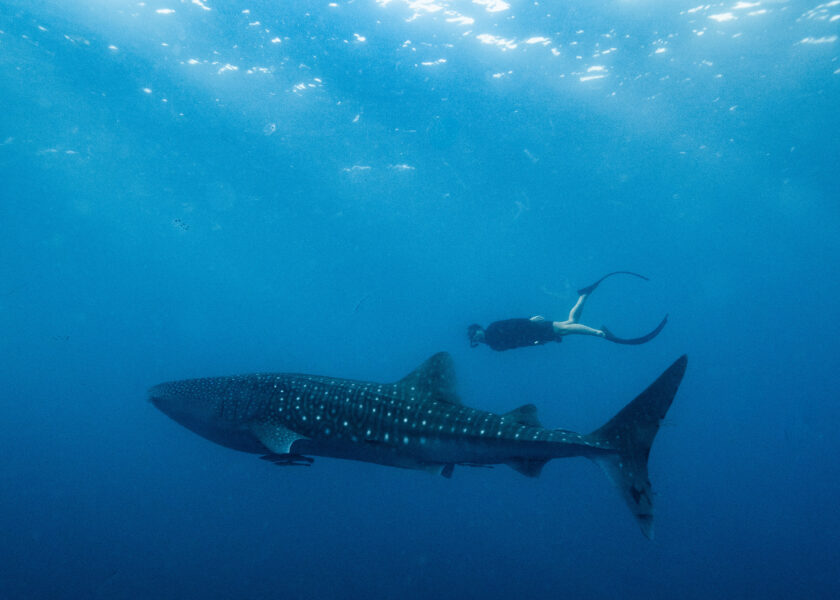
The furthest and most demanding excursion begins in genuine darkness. Amanwana’s speedboat departs at four in the morning, Moyo falling away into silhouette as the outline of Mount Tambora rises ahead against the pre-dawn sky. Tambora’s 1815 eruption is still the largest in recorded history. Saleh Bay is warmed and enriched by exactly this volcanic geology, and it holds whale sharks year-round. By the time the sun clears Tambora’s crater rim, the shapes beneath the boat are unmistakable. Every excursion runs in partnership with Yayasan Konservasi Indonesia, tagging and tracking the sharks that pass through the bay.
Inland, a jeep track winds towards Barry’s Falls, also known as Mata Jitu, the limestone-pool waterfall at Moyo’s centre. Crocodile Head rewards a different kind of walk: a ridge trail leading to a headland where the Flores Sea opens without warning below, Sumbawa’s outline visible through morning haze.
Evenings shift into something closer to ceremony. Bakela – meaning sharing from one platter – is Amanwana’s signature dinner, Sumbawanese dishes served lesehan-style on low tables and woven mats. On quieter nights, Barefoot on the Beach lays a private table directly on the sand. Sunset Point offers cocktails, canapés or a charcoal barbecue of grilled lobster from a volcanic ridge, with nothing between the table and the horizon.
Bawah Reserve: Six of the most remote Indonesian islands, reached by seaplane
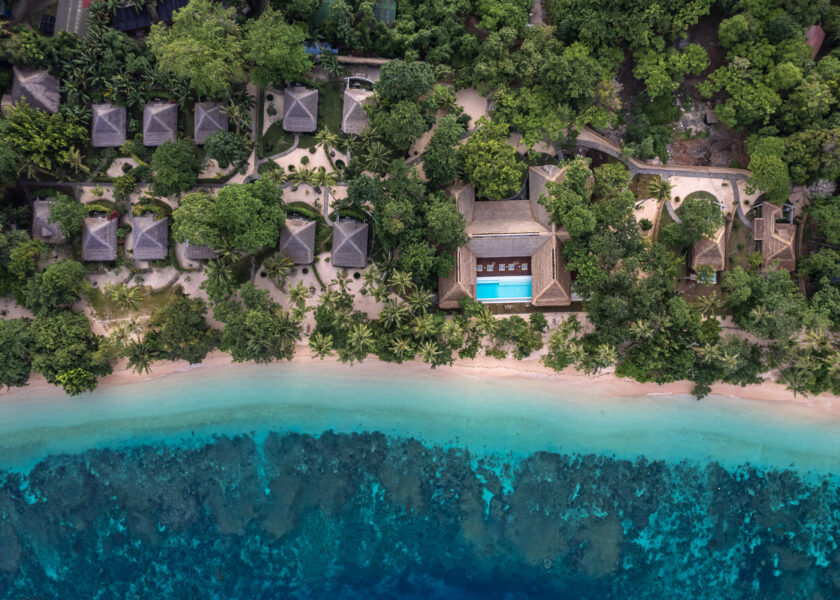
A seaplane delivers guests directly onto Bawah Reserve’s lagoon, the floats touching down on water clear enough to see the reef below before the engines even cut. From there, six islands, three lagoons and 13 beaches lie ahead. There is no reception desk, no queue – only a cold drink and an electric buggy waiting in the shade.
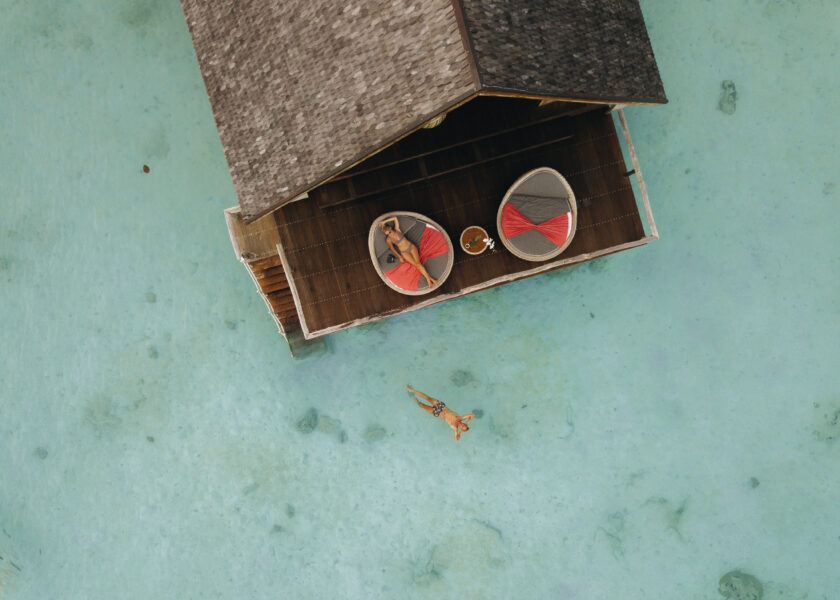
Overwater Bungalows stand on stilts above the lagoon, daybeds positioned to catch sunrise or sunset depending on which side they face. The jungle-set Treehouse Lodge strikes the opposite note, birdsong replacing surf, canvas roofs stretched over private verandas built from reclaimed timber and bamboo. Getting from one island to the next rarely feels like transport so much as an extension of the morning. Guests paddleboard or kayak across water still enough to double as a mirror, or take a resort boat to a private beach with nothing arranged beyond a picnic basket.
Heat, cold and a new wellness circuit at Bawah Reserve
Wellbeing here has recently expanded well beyond a conventional spa menu. Aura Spa Explorer scatters treatment pavilions across several of the six islands, turning an afternoon of massages into a guided tour of the reserve’s quieter corners. Adjacent to it, the newly built Aura Wellbeing Sanctuary offers a full contrast-therapy circuit: a red salt sauna at up to 82 degrees, a steam room, a Polar Room chilled to 16 degrees and an ice plunge pool held at 12. Guests move between heat and cold in a sequence designed to leave the body recalibrated rather than merely relaxed.
Sustainability shapes the guest experience as directly as the architecture does. A permaculture garden supplies a meaningful share of the kitchen’s fruit and vegetables. Line-caught fish arrives daily from local fishermen. The surrounding waters have been protected as a marine sanctuary since before the resort opened, and they are closed to any boat beyond Bawah Reserve’s own.
After dark, there are no roads, no cars and barely any lights beyond the resort itself, so the sky takes over. Staff call it a billion-star hotel, only half joking.
bawahreserve.com | @bawahreserve
Misool: 20 years of reef recovery in Raja Ampat
Descend onto the reef at Misool and the first impression is one of density rather than any single dramatic sighting: colour and movement stacked from the surface down, schools of fusiliers parting and reforming around passing divers, coral cover so complete in places that the rock beneath disappears entirely. A manta ray glides overhead without any apparent effort before banking back to a cleaning station, trailed by a cloud of small fish waiting their turn.
Inside the Misool Marine Reserve, 20 Years On
That abundance is the product of a 20-year experiment run by the resort’s founders. In 2005, they leased a 1,220-square-kilometre area of ocean from the indigenous communities holding rights to it. What they established became the Misool Marine Reserve, a no-take zone patrolled continuously since by rangers funded jointly by the resort and international conservation partners. The numbers, when they arrive, are almost hard to credit: independent surveys have recorded fish biomass increases of between 250 and 600 percent inside its boundaries compared with unprotected waters nearby, and shark populations roughly 25 times denser than outside them.
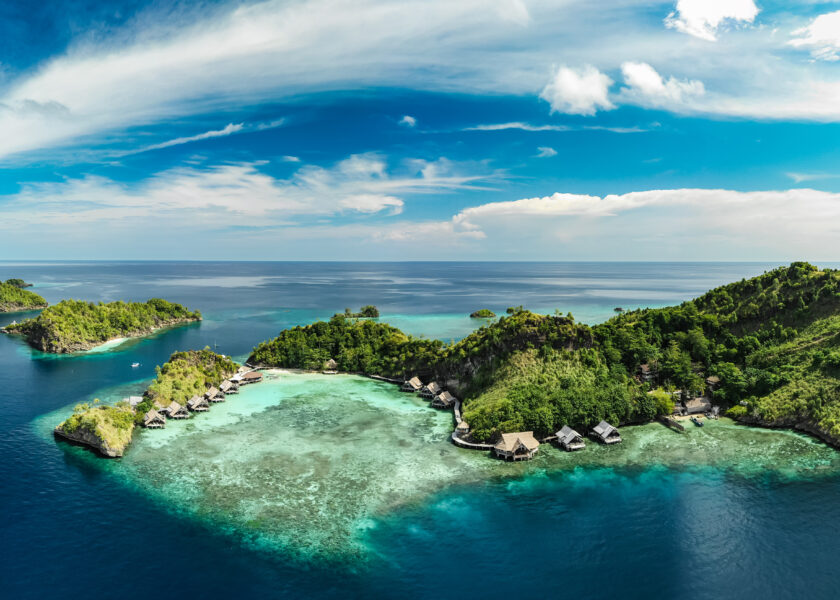
The resort’s water cottages and villas sit directly above this stretch of ocean, reached by a private jetty that places most of Misool’s signature dive sites within 15 minutes by boat. Non-divers are given equal standing rather than treated as an afterthought, with twice-daily guided snorkel trips to the same manta cleaning stations and coral gardens. Night dives on the house reef bring their own reward: the epaulette shark, a small, endemic species discovered only in 2006, using modified fins to walk across the shallow reef after dark.
A petition that protected an entire archipelago
Misool Resort’s influence reaches well beyond its own waters. In 2010, the resort’s founders presented a petition of more than 8,000 signatures to the Raja Ampat regency government. They campaigned alongside the conservation group Shark Savers for wider safeguards. The outcome, formalised in law in 2013, was a shark and ray sanctuary covering the entire Raja Ampat archipelago – roughly 27,000sqkm granted full protection for sharks, manta rays, dugongs and turtles.
Reaching Misool Resort requires effort: a lengthy combination of flights and boat transfers into the deepest reaches of southern Raja Ampat, among the remote Indonesian islands few travellers ever reach. What guests find at the other end is proof, visible on every dive, of what a reef can become when a resort decides to build its entire identity around protecting rather than merely enjoying it.
Coral Eye Bangka: Where marine research meets the reef
Bangka is one of the remote Indonesian islands most travellers skip entirely. Diving the waters around Bangka Island rewards a different kind of attention than a dramatic wall or a big-animal encounter. There is black volcanic sand here, apparently barren at first glance. It reveals itself slowly to anyone willing to move across it at a crawl: a mimic octopus reshaping its body and colour to imitate a flatfish mid-retreat, a flamboyant cuttlefish flashing through colours too vivid to seem biological, a blue-ringed octopus pulsing faint electric warnings from beneath a shell no larger than a coin. This is muck diving at its most theatrical, and Coral Eye sits at its centre alongside the nearby Lembeh Strait.
Marine biologists at the dinner table
What separates a stay here from a conventional dive holiday is what the site was before it became a resort at all. Four young marine biologists founded Coral Eye in 2009 as a research outpost, a shared base where universities and visiting scientists could exchange findings about the surrounding reefs long before a single guest room existed. A dive centre followed in 2013, opening the site to travellers for the first time. The research culture never left with the tourists.
Guests share meals with working marine biologists as a matter of course. Dinner conversation is as likely to cover coral disease or microplastics as anything from a guidebook. Visiting researchers periodically return to reefs first surveyed in 2013 under a protocol developed by Professor Massimo Ponti, comparing years of change reef by reef. Each year, PLATFORM, Coral Eye’s research incubator, hosts a handful of early-career scientists for up to two months to develop their own projects in the field.
Sahaung, the area’s best-known dive site, delivers volcanic pinnacles draped in soft coral and schools of blue-striped snapper moving in dense formation. It is occasionally joined by a white-tip reef shark, cruising past divers who came for the smaller creatures and find themselves surprised by the larger ones. The surrounding seagrass beds hold a rarer prize still — dugongs, sighted by fortunate divers most years, grazing quietly through meadows that also shelter pygmy seahorses.
Nearby Tangkoko National Park, reachable as a day excursion, is home to spectral tarsiers – among the smallest primates on earth – and black crested macaques, found nowhere outside this corner of Sulawesi. Coral Eye has also supported the No-Trash Triangle Initiative since 2018. It is working to build a waste management system for Bangka Island that can actually be sustained rather than simply announced.
coral-eye.com | @coraleyebangka
Only the Beginning
Five remote Indonesian islands, five resorts, and still barely a fraction of what 17,000 islands contain. Sumba’s horses, Moyo’s whale sharks and Raja Ampat’s mantas are not outliers in this country. They are simply five examples from an archipelago that produces this kind of wonder as a matter of course.
That is the real appeal of this country to a traveller who has already done the obvious circuit elsewhere. It does not run out. Somewhere in the Banda Sea, the highlands of Papua or the reefs off Alor, another island is quietly becoming someone’s favourite place on earth.