


From its origins as Bali’s first international landmark to its present-day revival, Bali Beach Hotel, The Heritage Collection, unfolds as a story of continuity and legacy.
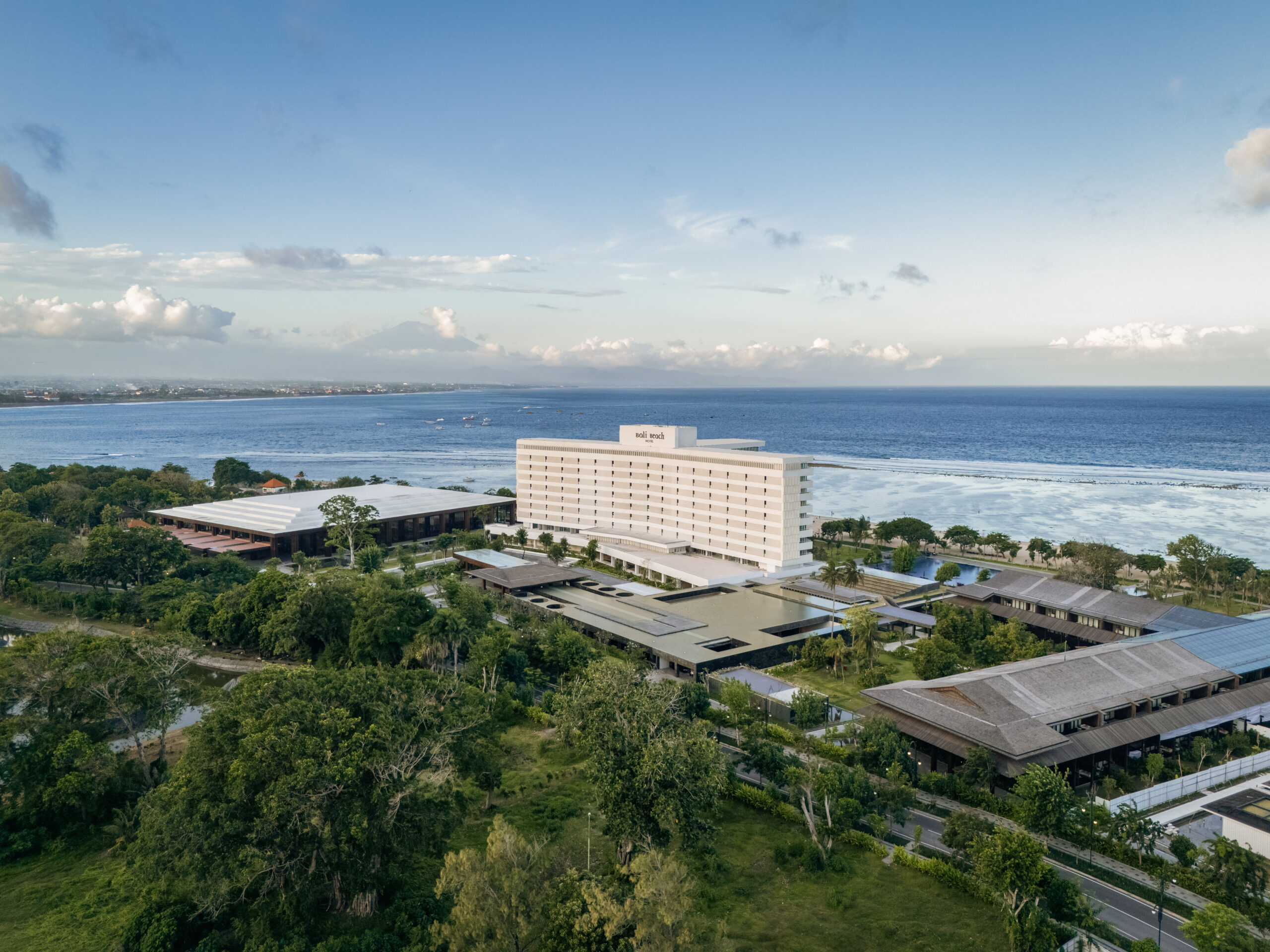
There are hotels that exist to accommodate, and then there are those that exist to signify. Rising along the shoreline of Sanur, Bali Beach Hotel, The Heritage Collection belongs unmistakably to the latter. Its presence is not merely architectural, but symbolic – an enduring marker of Indonesia’s early ambition, and a quiet witness to Bali’s transformation over the decades.
Long before the island became a global shorthand for tropical escapism – before villas multiplied across rice fields and beach clubs reshaped entire coastlines – this was where Bali first learned to welcome the world at scale. It stood as a gesture of openness, a physical manifestation of a young nation looking outward while holding firmly onto its identity. The shoreline of Sanur, calmer and more contemplative than the island’s more frenetic enclaves, provided a fitting backdrop for this introduction.
Today, its revival feels more like a reawakening that honours its past without becoming constrained by it, and that understands the quiet power of continuity in a destination that is constantly evolving. In many ways, Bali Beach Hotel does not attempt to compete with the new – it offers something the new cannot replicate: memory, context, and a sense of origin.
A monument to modern Indonesia

To fully grasp the significance of Bali Beach Hotel, one must return to the 1960s – a period defined by optimism, ambition, and the desire to position Indonesia on the global stage.
At the centre of this vision was Indonesia’s first President Sukarno, who saw tourism not merely as an industry, but as a cultural bridge. Bali, with its deeply rooted traditions and natural beauty, was chosen as the focal point of this vision. Yet rather than allowing it to be passively discovered, Sukarno sought to actively shape how it would be introduced to the world – framing it not as an untouched paradise, but as a place capable of engaging with modernity on its own terms.
The construction of Bali Beach Hotel in 1966 was a bold declaration. As the island’s first and only 10-storey hotel, it stood in deliberate contrast to its surroundings – a vertical landmark rising above a predominantly low-rise landscape. It was, in many ways, a symbol of modern Indonesia: confident, forward-looking, and unafraid to stand apart. Its presence alone altered the visual and cultural rhythm of Sanur, establishing a new point of reference for what the island could become.
Over the decades, the hotel evolved alongside Bali itself. Renamed Grand Inna Bali Beach, it became woven into the island’s collective memory – a place where international visitors first encountered Bali in a more structured, cosmopolitan way, and where local narratives intersected with global ones. Its corridors carried not just guests, but eras.
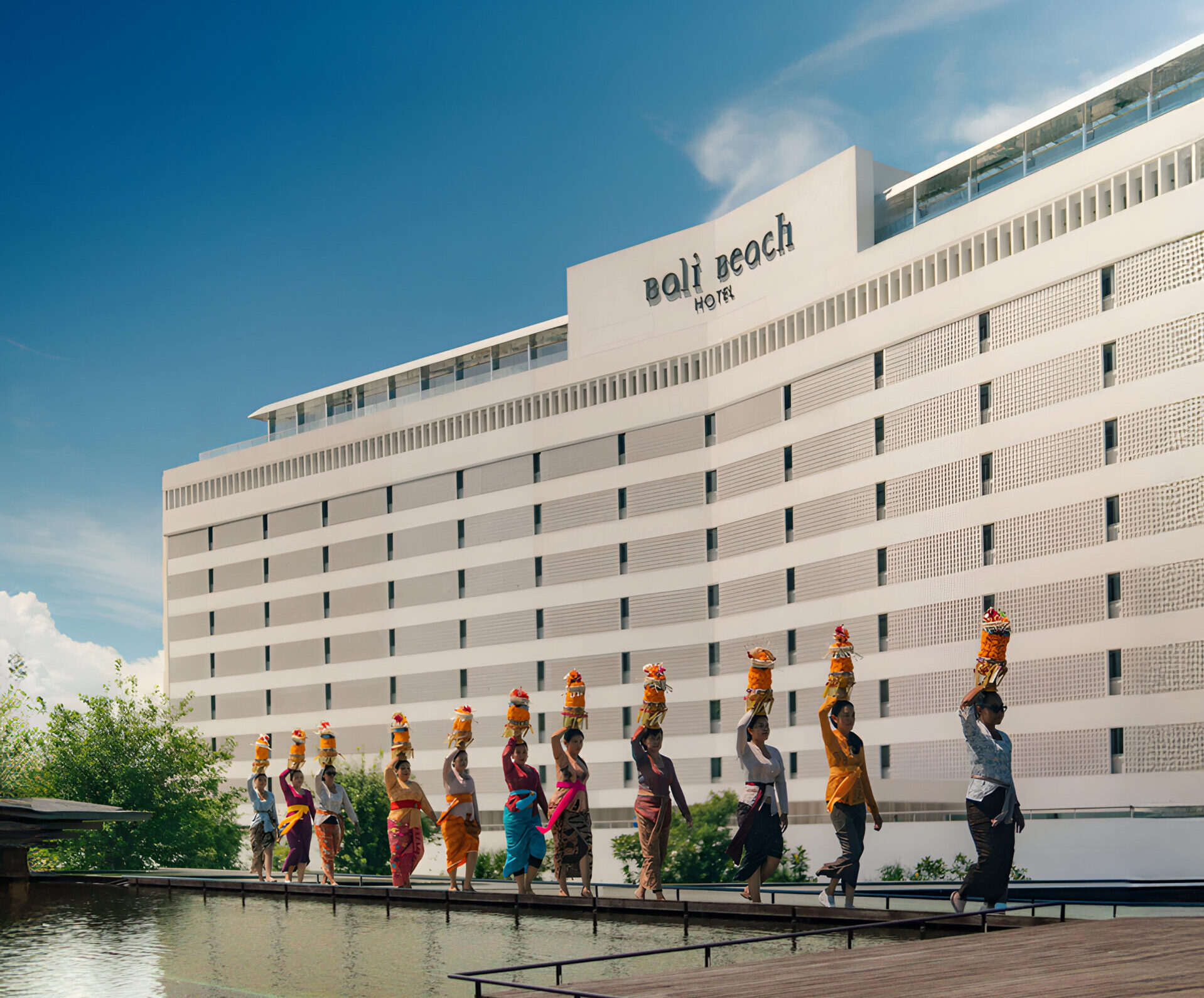
Yet time, as it inevitably does, introduced distance. As Bali expanded – moving through phases of development, reinvention, and reinvention once again – new properties emerged, each responding to changing expectations. Against this backdrop, the hotel’s prominence softened. It did not disappear, but it receded, becoming less visible even as its significance remained. Its rebirth in early 2024, as Bali Beach Hotel, The Heritage Collection, is therefore not simply a renovation – it is an act of restoration in the truest sense.
The approach is notably restrained. Rather than erasing the past, the redesign – led by Indonesian architects Gregorius Supie Yolodi and Maria Rosantina – retains the original structure and materiality, allowing the building’s history to remain visible. Granite-textured surfaces and marble finishes are preserved, their subtle imperfections becoming part of the narrative rather than something to be concealed.

New interventions are introduced with sensitivity. The tunnel-like lobby, for instance, is designed to guide – creating a sense of transition that prepares guests for the experience ahead without overshadowing the original tower. It is architecture presented as dialogue.
Inside, the conversation between past and present continues. The andesite stone mural by Harijadi Soemadijaja at the Sukarno Lounge serves as both focal point and anchor, a reminder that this is a space rooted in artistic and cultural expression as much as hospitality.
Set within the 42-hectare The Sanur complex – Indonesia’s first health and wellness-focused special economic zone – the hotel’s revival also reflects a broader shift in tourism.
This positioning within The Sanur places the hotel at the centre of a much larger transformation currently reshaping Sanur itself. Developed as Indonesia’s first integrated health and wellness special economic zone, The Sanur brings together healthcare, hospitality, wellness, and lifestyle facilities into a connected ecosystem designed around long-term wellbeing rather than standalone tourism experiences.
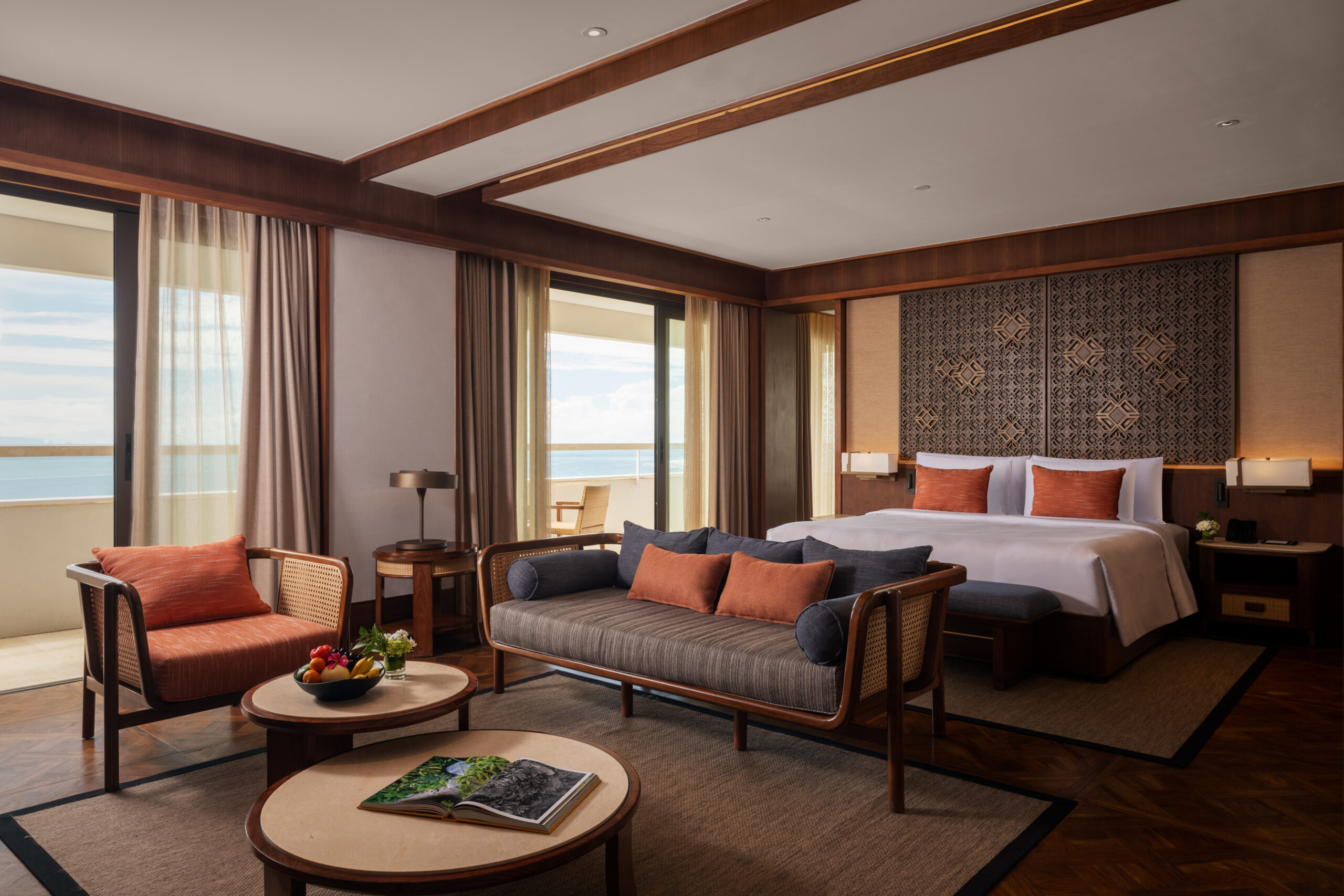
Alongside Bali Beach Hotel, the destination already includes Bali International Hospital (BIH), Alster Lake Clinic, The Meru Sanur, The Solitaire, and Bali Beach Convention Center, with future additions such as Alpha IVF & Women’s Specialists, JEC Eye Hospitals and Clinics, and soon-to-open Ethnobotanical Garden to further expand the ecosystem.
In this context, Bali Beach Hotel becomes more than a restored heritage landmark – it also functions as part of a broader contemporary vision for Bali, one that positions the island not only as a destination for leisure, but increasingly as a global hub for wellness, prevention, recovery, and quality of life.
It aligns itself with a growing emphasis on wellbeing, sustainability, and meaningful travel experiences, positioning itself not as an isolated destination, but as part of a larger, evolving ecosystem.
And yet, for all its scale and significance, there is a quietness to the hotel. It does not overwhelm. It invites. It asks to be experienced slowly, and in doing so, reveals itself more fully.
A culinary narrative of Indonesia
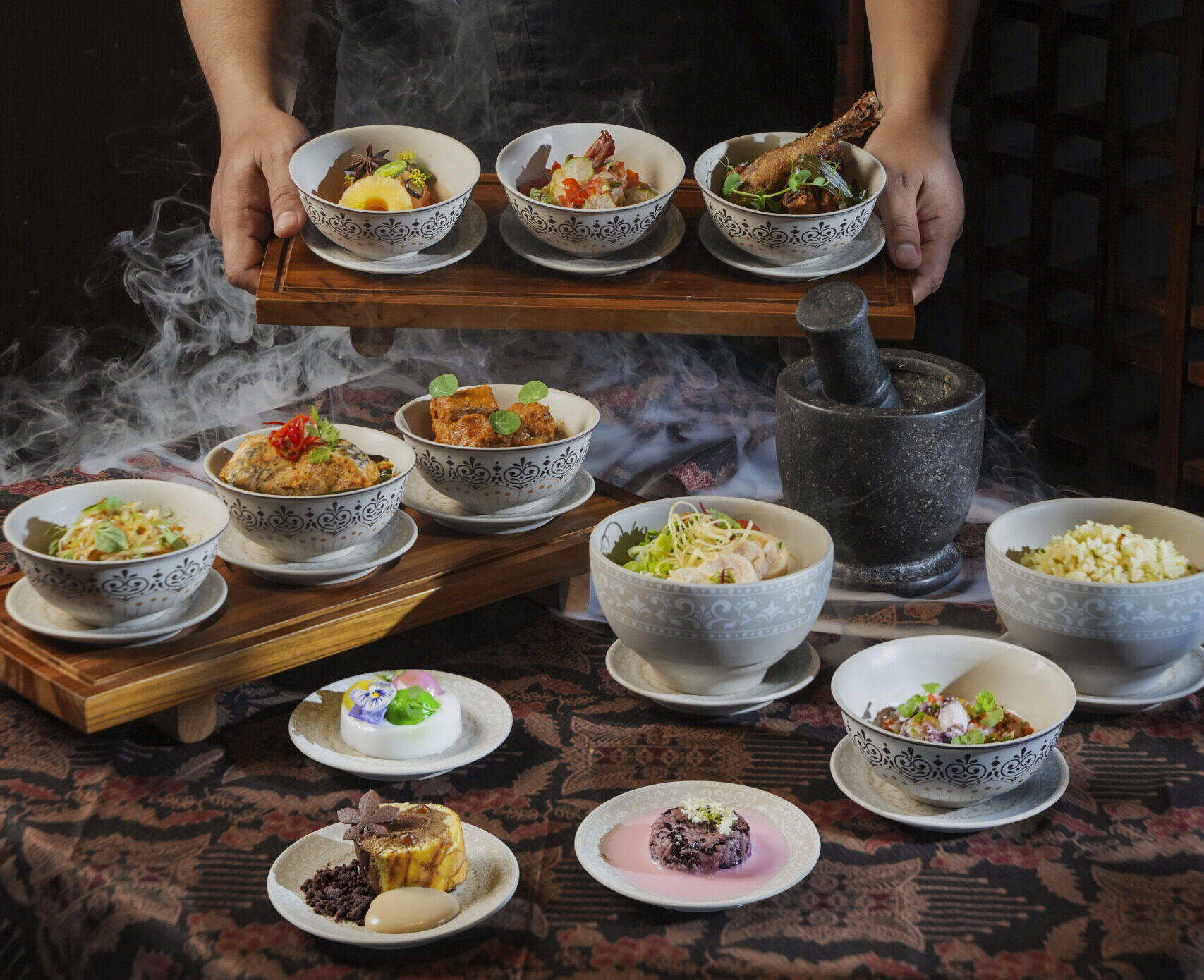
If architecture tells the story of the hotel’s past, its culinary programme brings that story into the present – alive, evolving, and deeply sensory.
At roso Restaurant, Indonesian cuisine is approached not as a static tradition, but as a living narrative. The word roso, meaning flavour or feeling, captures this duality. It is about taste, certainly, but also about memory, emotion, and identity.
Here, dining becomes a journey across the archipelago. Indonesia’s vast culinary diversity – shaped by geography, history, and cultural exchange – is distilled into a cohesive experience. From the bold, spice-driven dishes of Sumatra to the refined balance of Javanese cuisine and the coastal influences of Bali, each plate reflects a different facet of the nation’s identity.
Under the guidance of Executive Sous Chef Prima, the approach is rooted in connection. Dishes are contextualised. They carry with them a sense of origin, of place, of meaning – allowing guests to engage with Indonesian cuisine as story.
This philosophy finds its most immersive expression in Rasa Nusa, a curated dining experience featuring 22 signature dishes. It is a format that invites exploration without overwhelming, offering breadth while maintaining coherence. Guests move through flavours gradually, building an understanding of the archipelago through taste.

The environment itself plays a crucial role. Interiors draw from Indonesia’s artistic traditions, incorporating textures and materials that reflect the country’s cultural richness. Indoor and outdoor spaces flow seamlessly, framed by greenery and softened by ocean breezes.
At Arunika Restaurant, the tone shifts toward something more relaxed. Positioned along the beachfront, it mirrors the rhythm of Sanur – unhurried, open, and quietly social. The Family Sunday Brunch becomes a focal point, where live music introduces a gentle cadence to the experience. It is an affair that unfolds naturally, allowing conversations to linger and moments to stretch.
Elsewhere, the Beach Bar and Pool Bar embrace the coastal setting with simplicity – refreshing beverages, light fare, and a pace that aligns with the ebb and flow of the shoreline. Meanwhile, Sutasoma Lounge offers a more contemplative alternative, where crafted cocktails and Indonesian-inspired drinks are enjoyed in a setting that encourages pause.
Across all venues, there is a shared sensibility: that dining should not compete with its environment, but complement it. It is an approach that prioritises balance over excess, allowing both flavour and context to coexist.
A family-friendly hotel, reimagined

Family travel, at its best, is defined by connection. At Bali Beach Hotel, this understanding shapes the experience in ways that feel both intentional and intuitive. The Niskala Kids Club serves as its centrepiece, inspired by the Balinese concept of the unseen world – a space where imagination is encouraged and given structure.
Daily activities move fluidly between creativity and culture. Children might begin the day engaged in tote bag painting or tie-dye creation, before transitioning into Balinese arts and crafts or dance lessons. These experiences are not designed to create a rhythm that feels both engaging and natural.
Premium activities deepen this engagement. Canang or offering making introduces children to the spiritual traditions of Bali, while kite making, cap painting, and canvas art sessions encourage hands-on creativity. Each activity becomes a point of connection. More importantly, these experiences are not confined to children. They extend outward, inviting participation from families as a whole.
A Balinese dance lesson becomes a shared exploration of movement and meaning. A Sanur bike tour offers a gentle journey through cultural landmarks, from conservation centres to temples and historical sites. Meanwhile, the Sanur village walk provides a slower, more reflective perspective – allowing observation, conversation, and understanding.
Leisure, too, is approached with care. Bicycle rentals encourage independent exploration, while water-based activities introduce elements of play without overwhelming the overall experience. The Family Getaways Package brings these elements together into a cohesive stay – one that prioritises ease, comfort, and shared moments.
Legacy in the occasion
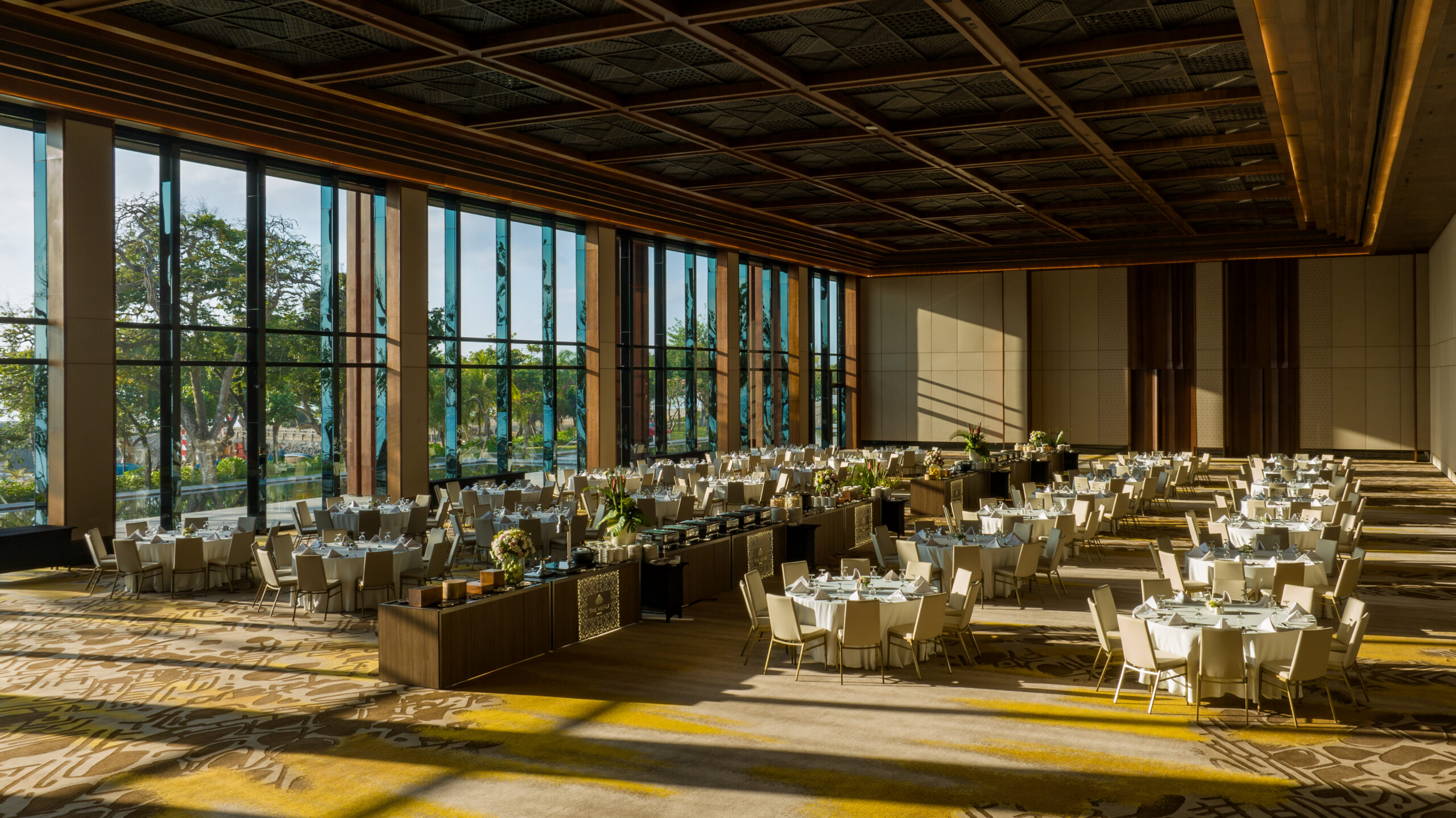
If Bali Beach Hotel began as a symbol of Indonesia opening itself to the world, it continues that role today through the gatherings it hosts. At the centre of this is the Bali Beach Convention Center, where Convention Halls 1, 2, and 3 together form the largest convention venue in Denpasar. Spanning 3,750sqm, with ceilings rising to 8.5m and capacity for up to 5,000 guests, the space is designed to accommodate events of significant scale.
Yet what distinguishes it is its setting. Positioned against the serene backdrop of Sanur Beach, it offers a rare combination – where large-scale gatherings unfold within an environment that remains inherently calm.
For more intimate occasions, the Agoong and Batoor Rooms offer a refined alternative. Located on the first floor, these seven meeting spaces range from 40 to 220sqm, accommodating up to 220 guests. Designed with both elegance and functionality in mind, they provide a setting that supports both productivity and presence.
Beyond indoor venues, the hotel’s outdoor spaces introduce another dimension. The Garden & Beach Venue, framed by tropical greenery and overlooking the coastline, creates a setting that feels both natural and elevated – ideal for weddings, celebrations, and open-air gatherings.
In this context, weddings take on a particular resonance. Surrounded by gardens, architecture, and ocean, each ceremony becomes an experience shaped by place. Whether intimate or expansive, every detail is guided by a dedicated team, ensuring that each moment unfolds seamlessly. Here, events are rooted in context, elevated by design, and carried by the quiet significance of the setting.
A legacy that continues to evolve
What ultimately defines Bali Beach Hotel, The Heritage Collection is not simply its past, but its ability to remain present within it. There is a quiet confidence in its presence, offering something that cannot be newly built: a sense of continuity. The hotel reminds us that the most meaningful places are defined by what endures.
Beyond its architectural and historical significance, Bali Beach Hotel, The Heritage Collection also deepens its connection to Bali through the newly introduced Heritage Journey – an immersive cultural programme rooted in the philosophy of Tri Hita Karana, which emphasises harmony between people, nature, and spirituality.
Through thoughtfully curated experiences such as canang sari offering making, Balinese dance and music sessions, lontar engraving, incense crafting, and temple visits, the programme invites guests to engage with the island’s living traditions in a more personal and meaningful way. At its centre is the Sandikala Ritual, a sacred dusk procession held three times a week, where hotel associates carry tedung, lanterns, offerings, and traditional instruments across the property in a moving expression of balance between the natural and spiritual worlds.
Rather than presenting culture as performance alone, Heritage Journey reflects the hotel’s broader philosophy – one that understands luxury not merely through comfort, but through emotional connection, sincerity, and a deeper sense of place.
For more information, visit balibeachsanur.com and @balibeachsanur.